
Executive Summary
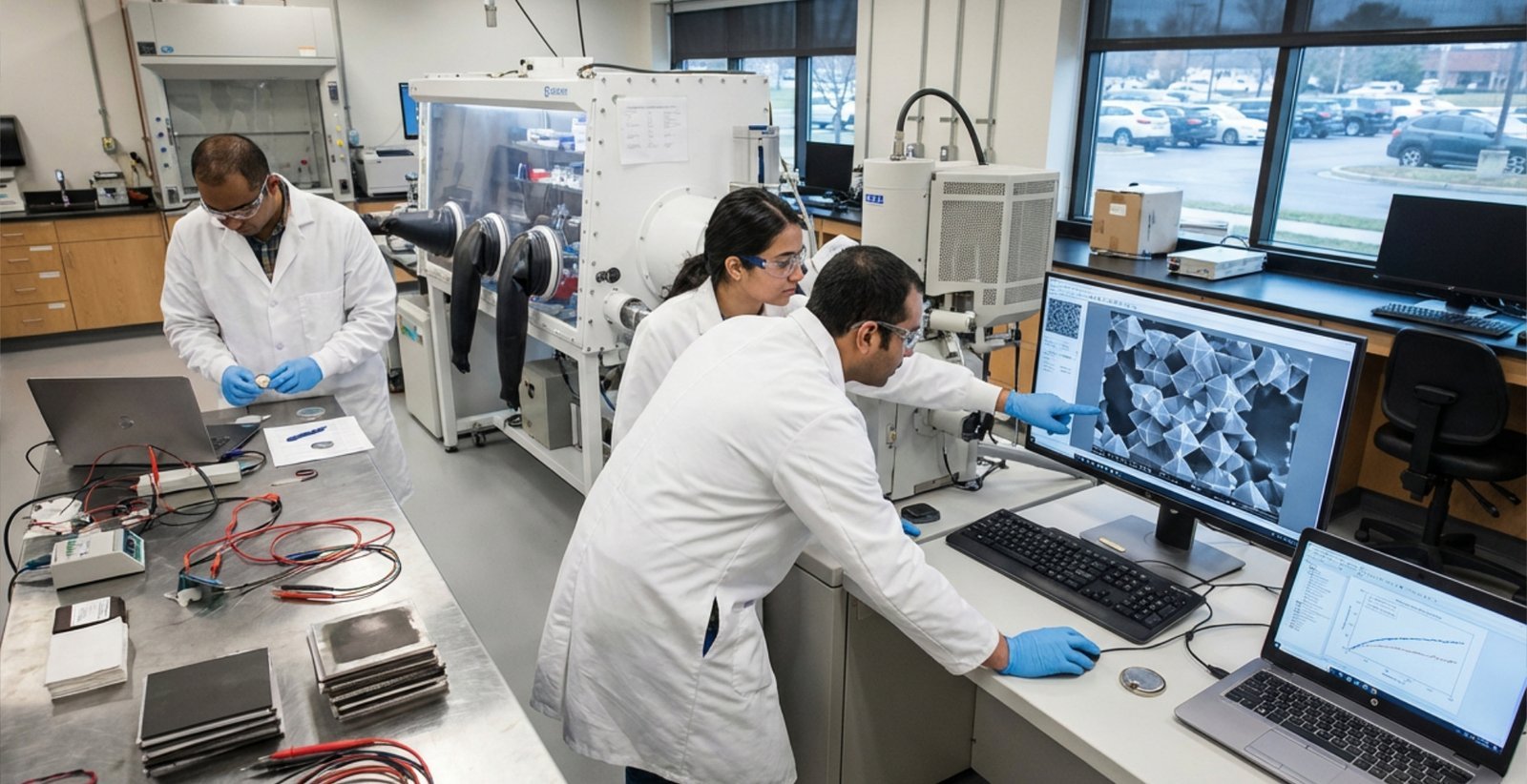
A breakthrough study from Argonne National Laboratory and UChicago Pritzker School of Molecular Engineering has revealed the hidden flaw behind underperforming single-crystal lithium-ion batteries. The findings redefine how electric vehicle (EV) batteries degrade and provide a roadmap to longer-lasting, safer, and more reliable EV power systems.
For automotive manufacturers, battery suppliers, and investors, understanding this newly discovered mechanical failure mechanism is crucial for strategic design, material sourcing, and product differentiation in a rapidly electrifying mobility market.
The Problem: Why Single-Crystal Batteries Underperform
Historically, polycrystalline nickel-rich cathodes (PC-NMC) suffered from grain-boundary cracking, limiting battery lifespan and raising safety concerns. Engineers adopted single-crystal nickel-rich layered oxides (SC-NMC) to avoid these boundaries, expecting higher durability.
Surprisingly, single-crystal cathodes still underperformed. The research revealed the root cause:
- Cracking in SC-NMC arises from uneven internal reactions within a single particle, rather than inter-grain boundary damage.
- Internal stress builds in localized regions during charge and discharge cycles, causing mechanical failure independent of traditional grain boundaries.
- Previously “harmful” elements like cobalt, contrary to prior assumptions, actually improve durability and extend battery life in single-crystal designs.
“The degradation mechanism in single-crystal cathodes is fundamentally different, requiring new design rules and material strategies,” says Jing Wang, lead researcher.
How Cracks Form
- Polycrystalline cathodes: Volume expansion/contraction during cycling creates cracks at grain boundaries, allowing electrolyte intrusion, chemical reactions, and capacity loss.
- Single-crystal cathodes: Internal regions expand at different rates, generating localized stress. Cracks form without grain boundaries, producing a distinct degradation pathway.
This insight flips long-standing assumptions, guiding engineers toward next-generation cathode compositions.
Implications for EV Battery Design
- Material Strategy Shift: In SC-NMC cathodes, manganese can accelerate mechanical damage, while cobalt enhances stability-opposite to polycrystalline logic.
- Cost vs Performance: Cobalt is expensive, prompting the search for alternative elements delivering similar benefits.
- Safety and Reliability: Better understanding of internal stress patterns enables the design of batteries with longer lifespans, higher energy density, and reduced fire risk.
“Electrification of society needs everyone’s contribution. Trust in battery safety and longevity is essential for adoption,” emphasizes Khalil Amine, Argonne Distinguished Fellow.
Strategic Takeaways for C-Suite Leaders
- Rethink Material Procurement: Future EV cathode sourcing must consider mechanical failure pathways specific to single-crystal designs.
- Invest in R&D for Alternative Alloys: Balancing cost, safety, and performance is critical as cobalt supply remains constrained.
- Enhance Product Differentiation: Longer-lasting, safer EV batteries can become a marketable advantage, addressing consumer concerns on reliability and warranty costs.
- Future-Proof Manufacturing: Understanding new degradation mechanisms allows OEMs and battery manufacturers to optimize design, scale production, and mitigate recalls.
Conclusion
This discovery marks a pivotal moment in EV battery innovation. By identifying the hidden cracking mechanism in single-crystal lithium-ion cathodes, researchers have opened a path to safer, longer-lasting batteries that could redefine electric mobility’s future.Organizations that integrate these insights into strategic R&D, procurement, and manufacturing will gain a first-mover advantage in the competitive EV landscape.
Long-term EV battery supply agreements shaping next-generation cell design read more