
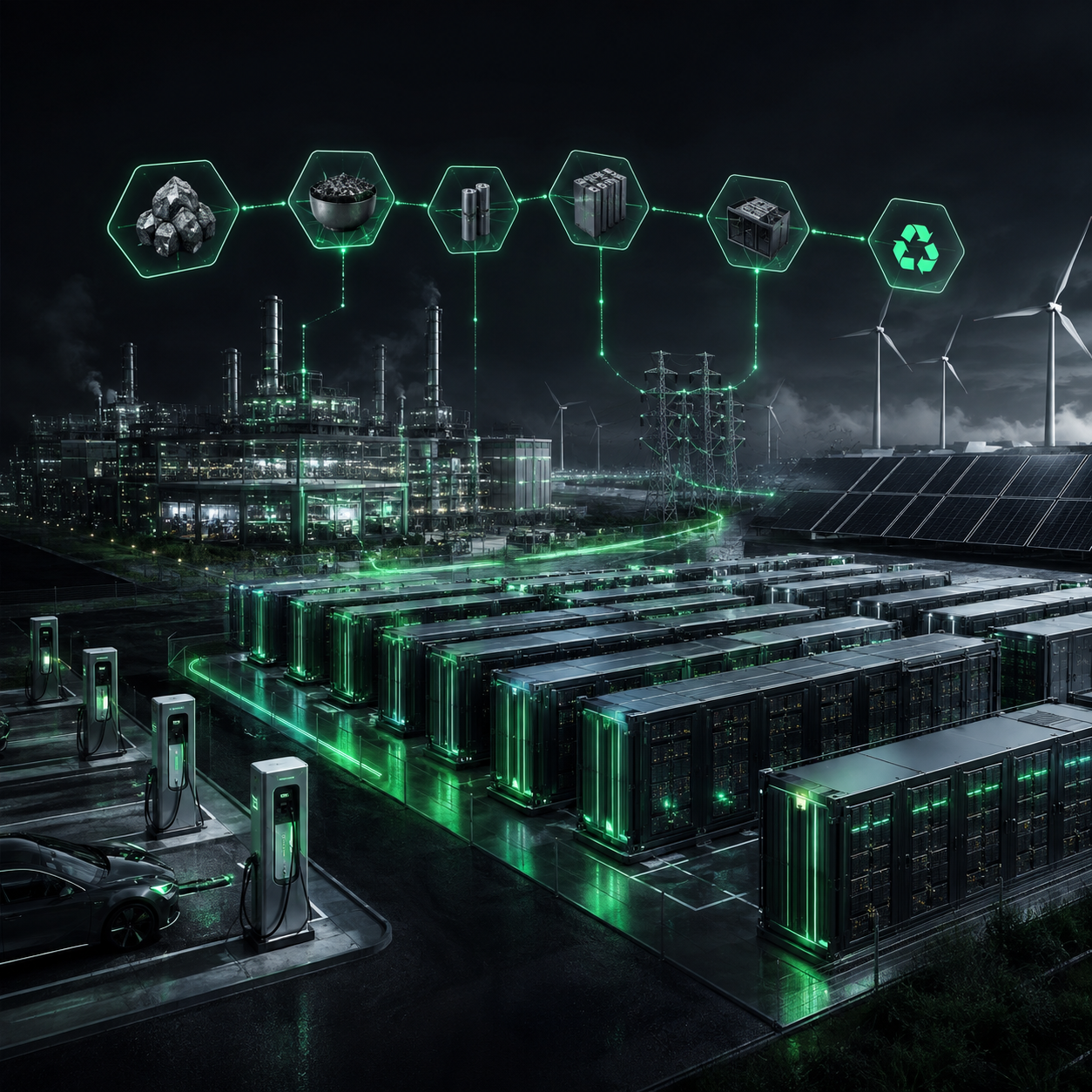
July’s Industry Developments Signal a Structural Shift Beyond Electric Vehicles
For much of the past decade, the global battery value chain has expanded around a single assumption: electric vehicles would remain the dominant source of battery demand. Investment decisions across mining, refining, cell manufacturing, and recycling have largely been guided by automotive production forecasts and EV adoption targets.
July 2026 developments indicate that the industry is entering a more diversified phase. While electric vehicles continue to drive demand, stationary Battery Energy Storage Systems (BESS) are becoming an equally important strategic market, influencing capital allocation, manufacturing priorities, and long-term supply chain planning.
CATL’s Latest Results Highlight a Broader Industry Trend
CATL, the world’s largest battery manufacturer, reported a 42% year-on-year increase in first-half 2026 net profit, with its energy storage business accounting for approximately 19% of total revenue. Although electric vehicle batteries remain its largest business segment, the continued growth of stationary energy storage demonstrates that battery demand is expanding beyond transportation.
The company’s performance reflects broader market dynamics rather than an isolated success. Governments, utilities, renewable energy developers, and industrial operators are accelerating investments in battery storage to improve grid reliability, integrate renewable energy, and strengthen energy security.
For companies operating throughout the battery value chain, this represents an important market signal rather than simply another earnings announcement.
Why Energy Storage Is Becoming a Strategic Growth Driver
Several structural factors are contributing to the rapid expansion of stationary energy storage.
Grid Modernization
Electricity networks are increasingly relying on battery storage to balance renewable energy generation, improve grid stability, and reduce peak demand pressures.
Renewable Energy Integration
As solar and wind capacity continues to expand globally, battery storage has become an essential component for managing intermittent power generation.
Energy Security
Governments and industrial operators are investing in energy storage infrastructure to improve resilience against supply disruptions and strengthen long-term energy independence.
Collectively, these developments are creating a second structural demand driver alongside electric vehicles.
What This Means Across the Battery Value Chain
The implications extend well beyond battery manufacturers.
Mining and Raw Materials
Demand forecasting can no longer rely exclusively on vehicle production. Utilities, renewable energy developers, and infrastructure operators are becoming increasingly significant battery customers, introducing new procurement cycles and investment horizons.
Chemical Processing and Refining
The growth of stationary storage broadens the commercial deployment of battery chemistries. Refiners and chemical producers will require greater operational flexibility to support customers across multiple applications.
Cell and Pack Manufacturing
Manufacturers are balancing production between automotive contracts and rapidly expanding energy storage projects. Capacity planning, product mix, and manufacturing flexibility are becoming increasingly important competitive advantages.
Manufacturing Equipment and Technology
Demand is shifting toward automation, quality control, digital manufacturing, and production systems capable of supporting multiple battery applications efficiently.
Recycling and Circular Economy
As deployment increases across transportation and stationary applications, end-of-life battery volumes will continue to rise, reinforcing the importance of scalable recycling infrastructure and critical mineral recovery.
Strategic Questions for Industry Leaders
The latest market developments raise several important questions for executives.
Investment Strategy
Should capital allocation continue to prioritize automotive demand, or should investment portfolios increasingly account for stationary energy storage?
Supply Chain Resilience
Are existing supply chains designed to support both automotive manufacturers and utility-scale energy storage developers?
Manufacturing Flexibility
Can current production facilities efficiently respond to changing demand across multiple battery applications?
Long-Term Competitive Positioning
How should organizations prepare for a battery market supported by two structurally different demand drivers?
Looking Ahead
Electric vehicles will continue to represent one of the largest drivers of battery demand. However, July’s industry developments suggest that the future growth of the battery value chain will increasingly be shaped by both transportation and energy infrastructure.
Companies that recognize this transition early will be better positioned to align investment priorities, strengthen supply chain resilience, and capitalize on opportunities emerging across a more diversified battery ecosystem.
Key Takeaway
Energy storage is no longer simply an adjacent market for battery manufacturers. It is becoming a strategic growth engine that is reshaping investment decisions across mining, refining, manufacturing, equipment, and recycling.
As transportation and stationary storage continue to develop in parallel, competitive advantage will increasingly depend on an organization’s ability to serve both markets through flexible operations, resilient supply chains, and long-term strategic planning.