The global battery industry has spent the last several years focused on one dominant concern: securing critical minerals.
Lithium, nickel, graphite, cobalt, manganese. These materials have become central to industrial policy, geopolitical competition, and long-term manufacturing strategy. Yet while governments and corporations race to secure mineral supply chains, another constraint is quietly emerging beneath the surface:
Water.
For battery manufacturers, water is not merely a utility expense. It is operational infrastructure. And in many regions, it may soon become one of the defining limitations on battery production scalability.
The Overlooked Infrastructure Dependency
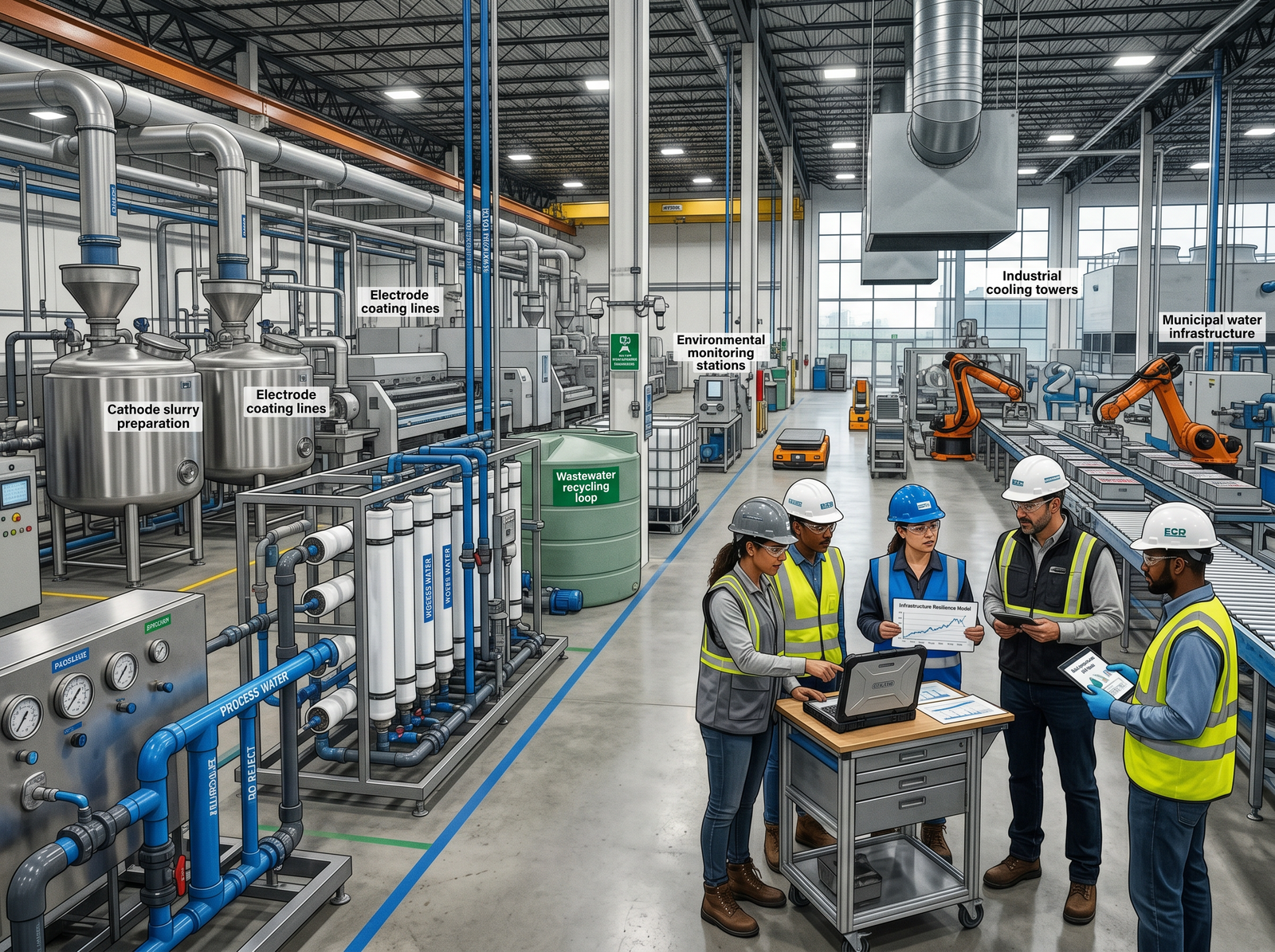
Gigafactories require enormous quantities of water across multiple stages of production. Ultra-pure water is essential for:
● electrode manufacturing
● slurry preparation
● chemical processing
● cooling systems
● humidity control
● battery cell cleaning
● emissions management systems
Cathode and lithium refining facilities can consume even larger volumes depending on chemistry and purification requirements.
As battery plants scale toward multi-gigawatt-hour output, water consumption rises alongside energy demand, often faster than local infrastructure expansion can support.
While lithium shortages dominate headlines, water permitting delays are increasingly becoming a hidden variable in project timelines.
Why This Matters Now
North America is aggressively expanding domestic battery manufacturing capacity.
The Inflation Reduction Act, regional sourcing mandates, and supply chain localization strategies have accelerated announcements for:
● gigafactories
● cathode active material plants
● lithium refining facilities
● recycling operations
Many of these facilities are being built in regions that are simultaneously facing:
● drought risk
● aging water infrastructure
● industrial competition for water access
● environmental permitting pressure
The challenge is no longer simply:
“Can a company build a battery plant?”
The more strategic question is:
“Can the surrounding infrastructure sustain industrial-scale battery production for the next 20 years?”
The Semiconductor Parallel
The semiconductor industry faced similar challenges years earlier.
Chip fabrication facilities require ultra-pure water at massive scale, forcing manufacturers to invest heavily in:
● water recycling systems
● municipal partnerships
● dedicated treatment infrastructure
● closed-loop water recovery
Battery manufacturing may now be entering a similar phase.
As plants become larger and more chemically sophisticated, water resilience could evolve from a sustainability metric into a core competitive advantage.
Companies that secure stable long-term water access may gain operational advantages that competitors cannot easily replicate.
Water Risk Is Becoming an Investment Risk
Institutional investors increasingly evaluate infrastructure resilience alongside production capacity.
For battery projects, water-related risks now influence:
● permitting timelines
● insurance costs
● ESG assessments
● operational continuity
● regional expansion viability
In some jurisdictions, water constraints may ultimately determine whether announced projects move beyond the planning stage.
This is particularly relevant as the industry shifts from pilot-scale operations toward full industrial maturity.
Recycling Will Not Eliminate the Problem
Battery recycling is often presented as a long-term solution to supply chain pressure. However, recycling infrastructure itself also requires substantial water and chemical processing capacity.
As recycling scales, competition for industrial water access may intensify rather than decline.
The conversation is therefore evolving from mineral scarcity toward broader resource ecosystem management.
The Strategic Opportunity
The companies that recognize water as strategic infrastructure early may gain significant advantages in:
● site selection
● regulatory approvals
● operational stability
● public-private partnerships
● long-term production economics
This creates opportunities for:
● water treatment providers
● industrial infrastructure firms
● recycling technology developers
● municipal utilities
● sustainability engineering companies
In many ways, the future battery race may not simply be about who controls lithium reserves.
It may increasingly depend on who controls the infrastructure required to process those materials sustainably at scale.
Final Thoughts
The battery sector is entering a new phase of industrial maturity.
The first phase focused on technology.
The second focused on raw materials.
The next phase may center on infrastructure resilience.
Water is unlikely to dominate headlines in the same way lithium or EV demand projections do. Yet behind every gigafactory announcement lies a more practical question:
Can the surrounding ecosystem support industrial production at scale?
For manufacturers, investors, and policymakers alike, the answer to that question may shape the next decade of battery industry expansion.