The timeline for solid-state battery industrialization has officially shifted from laboratory breakthroughs to market-ready deployments. May 2026 marked a pivotal transition phase for the global energy value chain, characterized by the commercial launch of semi-solid electric vehicles, major infrastructure investments, and aggressive standard-setting initiatives. For executive leadership tracking automotive and grid-scale storage assets, these updates signal a critical divergence in material pricing and supply chain readiness. Market Traction: May 2026 Industrial Milestones Rather than waiting for theoretical all-solid-state architectures to mature, the automotive sector is actively commercializing semi-solid variants to establish early market dominance.
● Commercial Vehicle Launch: SAIC officially brought its MG 4X to market, powered by a 53.9 kWh semi-solid battery delivering a 510 km range. The pack architecture operates with less than 5% liquid electrolyte.
● The All-Solid-State Cost Target: Gotion Hi-Tech unveiled its “Jinshi” all-solid-state cell. Boasting an energy density of 400 Wh/kg and passing rigorous nail-penetration safety testing, Gotion is aiming for an aggressive cost ceiling of 1 yuan/Wh ($0.14–$0.15/Wh) by 2030.
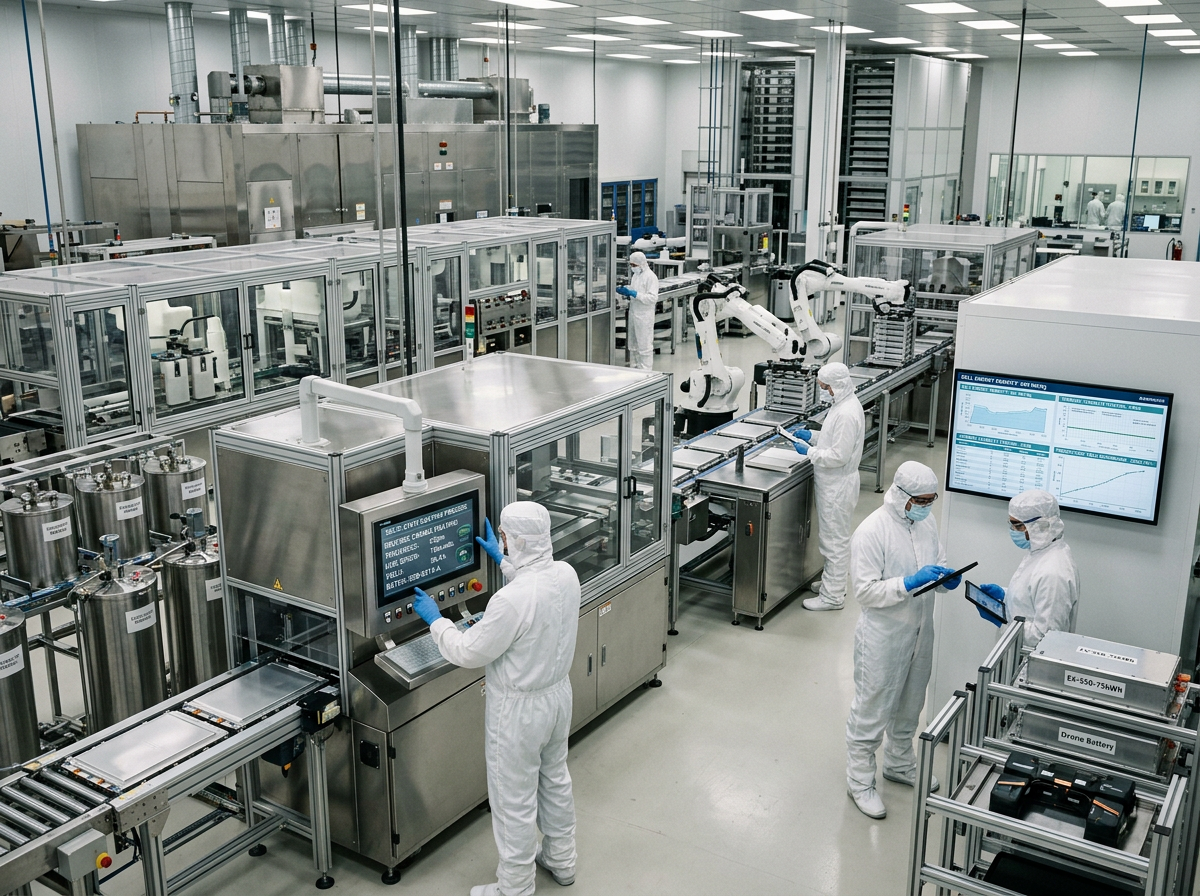
● Next-Gen Drone Deployment: Enpower launched its “Sky Series” specifically for the commercial drone market, delivering 403 Wh/kg to capitalize on higher-margin, low-volume aviation sectors.
Supply Chain Realities: Material Friction and Pricing Divergence
As solid-state battery industrialization scales, the underlying midstream material market is experiencing typical early-stage strain. A sharp divergence in electrolyte costs indicates that scaling up the upstream supply chain remains a primary bottleneck.
Sulfide electrolyte (LPSC) surged 176% due to P2S5 shortages and rising interest in sulfide routes. Concurrently, lithium metal anodes rose 8.5% and Gen 3 LFP cathodes increased 10.3%. Conversely, oxide electrolytes (LATP, LLZO) softened, dropping between 2% and 11%. While sulfide routes face sharp cost pressures due to precursor constraints, key players are building massive capacities to stabilize future supply. Gotion has targeted a production volume of 50,000 tons of lithium sulfide ($\text{Li}_2\text{S}$) and 100,000 tons of sulfide electrolyte by 2030 to achieve its long-term cost reductions.
Capital Flows and Corporate Scaling
Institutional capital is flowing heavily into both domestic production capacity and public market liquidity:
● Public Market Listings: ProLogium announced its impending U.S. NASDAQ debut via a SPAC merger at a pre-money valuation of $3.8 billion. Concurrently, Solid Power is expanding its operational footprint across the US, Europe, and South Korea.
● Private CAPEX Injections: Massive regional projects are entering active implementation. Qingtao Energy advanced its 5-billion-yuan ($700M USD), 20 GWh zero-carbon manufacturing plant in Hohhot, while Guoxiang Century launched a 10-billion-yuan solid-state industrial complex in Shanghai.
● High-Net-Worth Backing: Zhong Shanshan directed a 500-million-yuan personal investment into Zhibang Lithium, signaling strong institutional confidence in next-generation electrolyte chemistry.
Policy, Standardization, and Stepwise Adoption:
Regulatory bodies are moving swiftly to formalize the terminology and safety frameworks governing these assets. China’s Ministry of Industry and Information Technology (MIIT) has officially prioritized solid-state battery standards as a core task for its 2026 automotive standardization program. Under emerging national standard frameworks (GB/T), a true solid-state cell must exhibit a mass loss of $\le\text{0.5\%}$ at 120°C, while semi-solid designs are explicitly categorized as “mixed liquid-solid batteries”.
Global executives, including leadership at Nissan and Gotion, advocate for a “stepwise commercialization” matrix. Because the supply chain for all-solid-state architectures remains immature for immediate automotive scaling, the entry strategy centers on securing early yield and returns in high-end consumer electronics and drones before transitioning into high-volume EV fleets.
Market projections indicate that semi-solid-state battery shipments will reach 160 GWh by 2028, acting as the primary stepping stone to high-volume automotive fleets. In contrast, all-solid-state shipments are projected at 13.5 GWh by 2028, representing roughly 4% of the global market share by 2030. By 2035, the total global penetration of solid-state technology is projected to approach 10%. C-suite leaders must balance their current liquid lithium-ion lines with strategic, phased investments into these next-generation chemistries to prevent long-term portfolio obsolescence.