
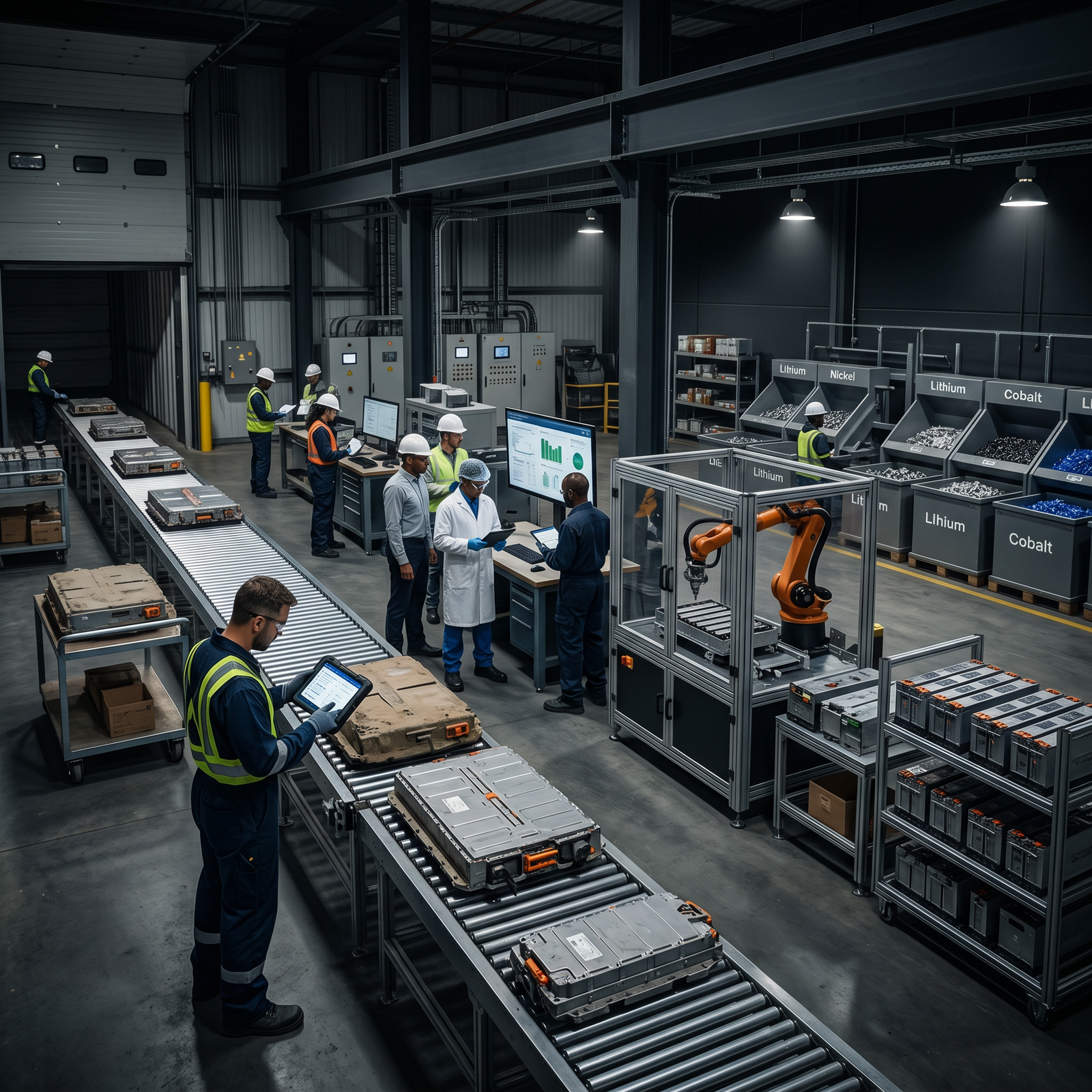
For much of the past decade, the battery industry focused on one objective: scaling production.
Manufacturers invested heavily in gigafactories, secured critical mineral supply, and expanded cell manufacturing to meet rapidly growing demand for electric vehicles and energy storage.
That race is far from over.
But as the industry matures, competitive advantage is beginning to expand beyond production capacity to how batteries are managed throughout their entire lifecycle.
During London Climate Action Week, CATL joined companies including Google, BMW, Renault, Volvo, and Xiaomi to launch a global initiative to develop common standards for battery circularity and lifecycle management. The proposed Battery Circular Design Guide, expected in 2027, aims to establish consistent approaches for battery diagnostics, pack disassembly, remanufacturing, and end-of-life management.
The announcement is less about publishing another technical framework and more about addressing one of the industry’s next structural challenges.
Why Battery Lifecycle Standards Matter
The battery industry has made remarkable progress in manufacturing.
What remains less consistent is what happens after batteries leave the production line.
Methods for assessing battery health, determining residual value, supporting second-life applications, and recovering critical materials often vary between manufacturers and markets. That inconsistency creates uncertainty across the value chain.
A common framework could make battery assets easier to evaluate, repair, remanufacture, and recycle while improving confidence among automakers, fleet operators, recyclers, and investors.
As battery volumes continue to grow, greater standardisation may become as important to market efficiency as manufacturing scale.
Battery Circularity Is Becoming a Business Strategy
Circularity is increasingly moving beyond sustainability reporting.
It is becoming part of long-term supply chain strategy.
Recovering lithium, nickel, cobalt, and other critical materials can reduce dependence on virgin resources, improve resource security, and help manufacturers prepare for increasingly stringent environmental and product regulations.
At the same time, better lifecycle management has the potential to improve operational efficiency while creating additional value from existing battery assets.
The Financial Value of Battery Asset Management
One of the most significant implications extends beyond manufacturing.
Consistent methods for measuring battery health and remaining useful life could improve how batteries are financed, insured, leased, traded, and reused.
Greater confidence in battery condition can strengthen secondary markets, improve residual value forecasting, and reduce uncertainty for fleet operators and financial institutions managing battery-backed assets.
As batteries become long-term economic assets rather than one-time products, lifecycle data is likely to become increasingly valuable.
The Executive Takeaway
The battery industry’s next phase will not replace the need for manufacturing scale. It will build upon it.
As production volumes continue to rise, the ability to evaluate, reuse, remanufacture, and recycle batteries efficiently will become increasingly important across the value chain.
CATL’s initiative reflects that broader transition.
The companies that create the greatest long-term value may not simply be those that manufacture the most batteries, but those that manage battery assets most effectively, from first use to second life and ultimately to material recovery.